1 October 2025
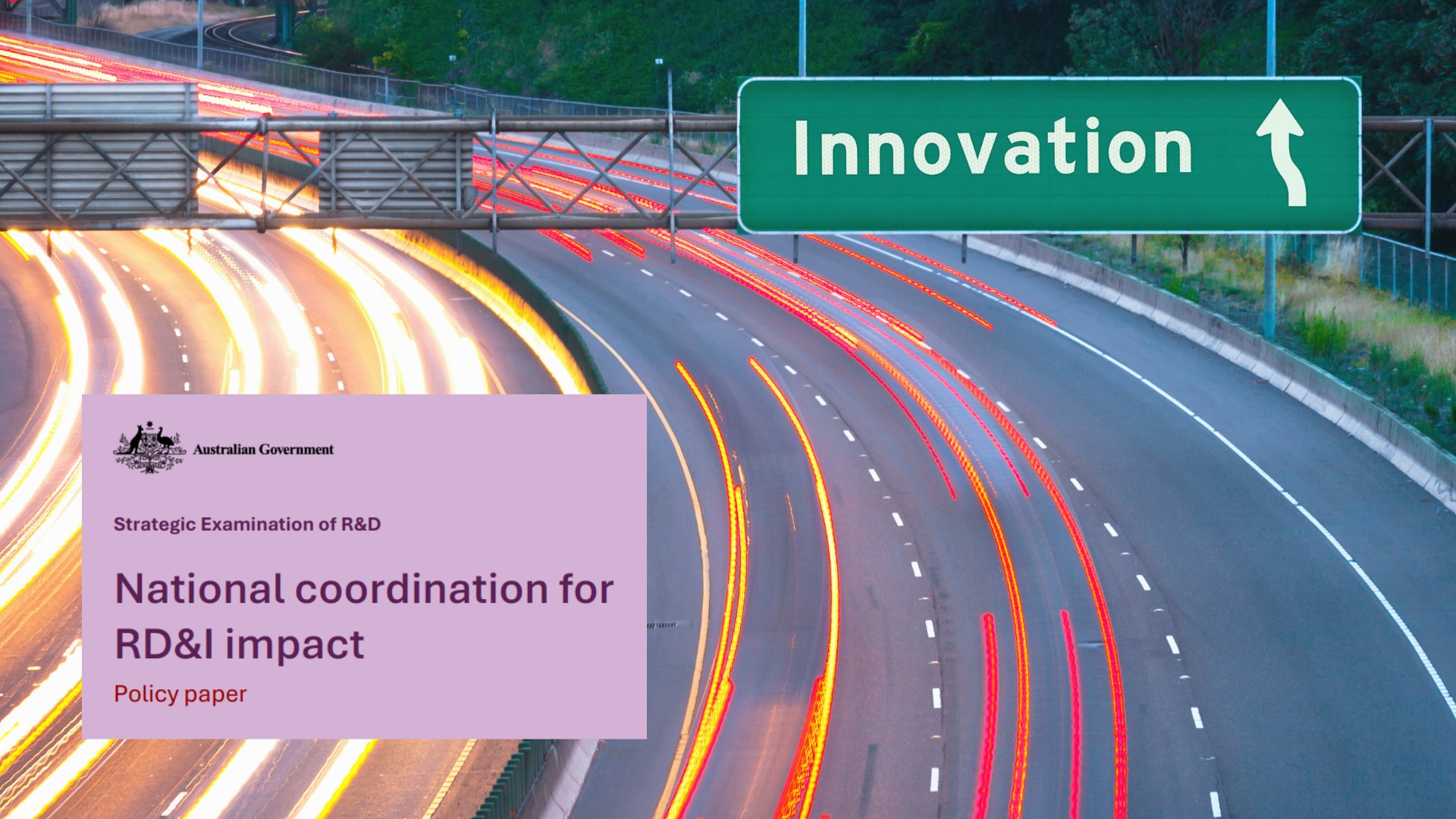
The SmartCrete CRC has submitted a recommendation to the Federal Government’s Strategic Examination of R&D (SERD) National coordination for RD&I impact policy paper. The paper details a proposed model for national coordination and impact to better catalyse change, grow capability across the system and build scale in areas of national need and global opportunity.
Australia’s research, development & innovation (RD&I) system is fragmented – too many uncoordinated programs, duplicated efforts, and inefficient competition for limited resources. This fragmentation is a major barrier to progress.
Defining long-term national RD&I priorities or focus areas will encourage collaboration, maximise the impact of public investment and better position Australia’s RD&I system to advance the national interest. Read below for our submission to the paper and recommendations for the proposed national coordination and impact model.
Australia exists within a complex global economy. Our economic outputs are fundamentally integrated into the global marketplace. Private investment in innovation is primarily driven towards creating return on investment opportunities, which means that innovation is directed towards market opportunities, rather than government priorities.
Markets typically move quickly, with major global technology developments often spinning off diverse economic opportunities as new market opportunities open. As a major example that is often sighted in market innovation literature, the economic opportunities supported by the internet, and major advancements in online connection since could not have been predicted in the 1980s.
Setting major national strategic innovation priorities for a 30-year period may run the risk of Australia locking into an innovation profile that misses unpredictable opportunities as they arise. Focus areas can easily become outdated as market forces change overtime, potentially leading to ‘white elephant’ government frameworks, established to support major innovation efforts in an area that may no longer be relevant on the global platform.
As an example, Australia is positioning itself to be a significant player in the renewable energy manufacturing space. Based on current priorities this seems like a safe bet; however, this effort could be destabilised by several developments, for example:
These are just hypothetical examples to demonstrate the point that we cannot predict what the future global market will look like. Rather than create specific focus areas to coordinate Australia’s public and private research effort, government should focus on creating an adaptive, responsive innovation ecosystem. This requires investment in the enablers of innovation, rather than the innovation itself.
National coordination for RD&I impact would be better framed through coordination of innovation enablers such as:
Outside key areas where government is a market driver through procurement, government policy and program interventions in markets should focus on enabling innovation rather than streamlining innovation to particular government priorities.
Australia’s innovation ecosystem is currently highly fractured and complex. Industry participants often report that there are simultaneously too many government funding programs, and not enough funding available. This scenario creates complexity, confusion and unnecessary competition in sourcing support to commercialise research outputs and, importantly, drive impact from innovation.
The SERD policy paper on national coordination of RD&I impact provides a strong framework for the coordination of government innovation support programs. In particular, recommendation 3, which talks to the coordination of RD&I support mechanisms, would provide important alignment across government support programs to coordinate and steward strategically important innovation efforts as they drive impact across the technology readiness levels.
The current innovation public investment framework is highly siloed. There is very low and often no coordination between the various innovation funding programs, meaning insights and information are not shared between programs and individual innovations have no way to seamlessly transition between programs. Alignment of major programs such as the ARC, NCRIS, Trailblazers, CRCs and Industry Growth Program as an example, could provide a fertile breeding ground that stewards innovations through the various stages of development and commercialisation to enhance impact potential. Active alignment across innovation programs would require departmental resourcing, similar to the grants management function that was previously provided by AusIndustry circa 2010.
Activities within this function might include;
If structured well, national coordination could empower Australia’s innovation capacity, leveraging our established advantages, and coordinating efforts to bridge major barriers to innovation collectively.

Clare Tubolets
Clare is the CEO of the SmartCrete CRC. She is passionate about unlocking collaborative potential by bringing together world-leading research and industry specialists to solve real-world problems.

NewsArticles, General29 September 2026
SmartCrete CRC has submitted a response to the Federal Government’s 2026-27 Safeguard Mechanism Review. This review follows from 2023 reforms...

NewsArticles, Interview29 July 2026
Originally published in Consulting Matters The next chapter of concrete innovation won’t start with a technical solution or a miracle...

NewsGeneral29 May 2026
Cooperative Research Australia’s 2026 Lifetime Achievement Special Commendation went to SmartCrete CRC Research Director and UTS Professor Vute Sirivivatnanon. The...

NewsArticles, Interview26 May 2026
Originally published in create (May 2026) The biggest barrier is often not invention but proving materials will perform safely for...