1 October 2025
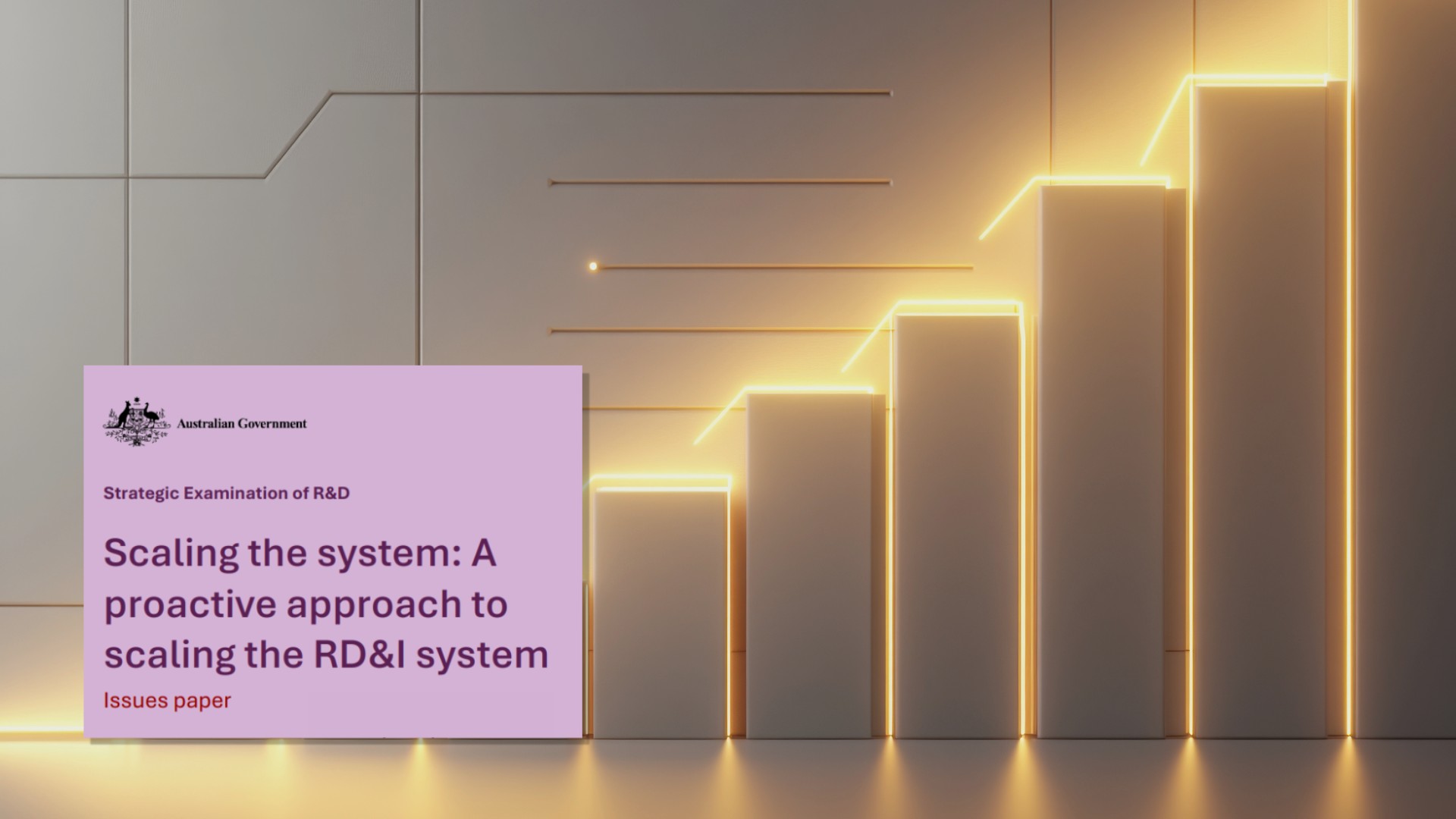
SmartCrete CRC has submitted a response to the Federal Government’s Strategic Examination of R&D (SERD) Scaling the system: A proactive approach to scaling the RD&I system issues paper. The paper is part of a wider strategic examination of R&D in Australia.
Australian researchers make an important contribution to the world’s knowledge, and a streamlined approach means we can better harness the potential of this knowledge to deliver greater value and sustained reinvestment. However, great RD&I impact can emerge from any business, sector, or any part of the community, so a system-wide design is needed.
This paper sets out where R&D supports should be focused to translate knowledge and achieve greater economic impact. Read below for our feedback on the paper.
The Strategic Examination of R&D, Scaling the system report beautifully showcases the challenge for Australia in harnessing the country’s high-performing research sector to create greater economic impact. Australia’s research sector consistently ranks above its scale in terms of research publications and citations, however there is limited translation of these research outputs into economic impact that creates jobs, global competitiveness and economic resilience.
Key to achieving this innovation impact is unlocking Australia’s collaboration capability between research and industry. Through the implementation of a government funded Cooperative Research Centre, the team at SmartCrete CRC has identified two core challenges to establishing effective industry-research collaborations that must be addressed in order to achieve real impact.
Career incentives for Australian academics are currently centred around two key outputs: publications and funding. Academics are incentivised and rewarded based on their publication volume (number of individual papers and citations), and ability to raise research investment in any category (competitive grants, government, industry and philanthropy, CRCs).
At times, these incentives can be at odds with industry objectives. For example, industry-led, applied research may require IP to be managed through commercial in-confidence, meaning the outputs cannot be published and will not contribute to an academic’s ranking for the purposes of recognition and career promotion. Furthermore, industry secondments or career breaks to pursue entrepreneurship detrimentally impact career trajectory, rather than enhancing it. This leads to very limited motivation for academics to consider publication-limited industry partnerships, or direct industry experience.
Disparate motivations, expectations and objectives of collaborating parties can often be a barrier to effective collaboration.
Typically, academics are driven by:
Typically, businesses are driven by:
At face value, these motivations can be seen as polarising and often block effective collaboration. However, when appropriately communicated, mutual objectives and motivations can be uncovered. For example;
SmartCrete CRC commends the solutions outlined in the SERD Scaling the Systems paper, particularly in relation to greater engagement between research and industry. Opportunities such as secondments and entrepreneurial skills development for researchers will support greater collaborative capacity between industry and research, unlocking the impact potential in Australia’s innovation ecosystem.

Clare Tubolets
Clare is the CEO of the SmartCrete CRC. She is passionate about unlocking collaborative potential by bringing together world-leading research and industry specialists to solve real-world problems.

NewsArticles, General29 September 2026
SmartCrete CRC has submitted a response to the Federal Government’s 2026-27 Safeguard Mechanism Review. This review follows from 2023 reforms...

NewsArticles, Interview29 July 2026
Originally published in Consulting Matters The next chapter of concrete innovation won’t start with a technical solution or a miracle...
NewsGeneral29 May 2026
Cooperative Research Australia’s 2026 Lifetime Achievement Special Commendation went to SmartCrete CRC Research Director and UTS Professor Vute Sirivivatnanon. The...

NewsArticles, Interview26 May 2026
Originally published in create (May 2026) The biggest barrier is often not invention but proving materials will perform safely for...