10 April 2025

Originally published in SAFE Structural And Foundation Engineering Newsletter (Issue 203 Dec 2024), this is a field trial update for our project Innovative Hybrid Footing for Light-Weight Structures in Expansive Soils.
By Biju Balakrishnan, Principle Structural Engineer, INTRAX Consulting Engineers
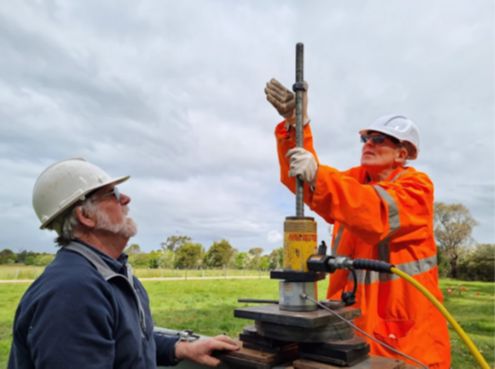
Conducted over eight weeks at a test site in Koo Wee Rup, near Pakenham, the program was made possible thanks to the generosity of ACSEV’s past president, Len Dalziel, who provided both the land and essential equipment, power, and tools.
A temporary office facilitated on-site operations, and extensive soil testing was conducted to characterize the ground conditions. Thanks to in-kind contributions from Hardcore Geotech, which supplied equipment and labour. Various in situ and laboratory tests were performed, including Standard Penetration Tests (SPT), Cone Penetration Tests (CPT), shrink-swell analysis, suction tests, and triaxial tests.
Based on the detailed soil profile, screw piles were installed at depths of 2.4, 3.3, 4.2, and 5.8 meters. A total of 28 test piles and 34 reaction piles were installed using hydraulic drive motors, with installation torques recorded using a calibrated Torque Hub. To ensure accuracy, a 48-hour period allowed the soil to mobilize its strength before testing. The piles were subjected to both compression and tension tests in accordance with AS 2159. Load and
deflection data were collected using advanced data loggers, calibrated string potentiometers for deflection measurements, and load cells for applied forces.
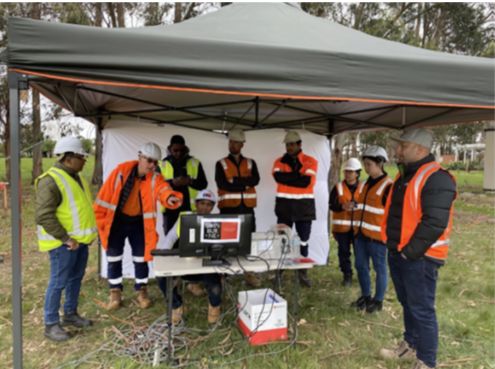 Volunteers from ACSEV and FFSV provided invaluable in-kind support throughout the testing phase. The tests were conducted under the expert supervision of Prof. Pat Rajeev by Dr. Aruna Karunaratne, Biju Balakrishnan (FIEAust CPEng), and Dr. Sri Srisangeerthanan. This collaborative effort has yielded significant data to better understand screw pile behaviour in tension and compression, enhancing engineering solutions for challenging ground conditions.

NewsArticles, Media Releases17 February 2026
Coverage from Leading Industry Outlets Highlights a Major Innovation in Low‑Carbon Concrete SmartCrete CRC participant Boral has been featured across...
NewsArticles, General2 February 2026
SmartCrete CRC has lodged a Pre‑Budget Submission for the 2026–27 Federal Budget on behalf of the Concrete Sustainability Alliance, requesting...

NewsArticles8 December 2025
Published in Inside Construction (Issue 21: Dec/Jan 2026) In precast, every millimetre counts. Sunset Sleepers has moved beyond the limits...

NewsArticles, General20 November 2025
The City of Newcastle took a bold step toward a greener future on Tuesday, November 11, 2025, with an education...