Projects
Status
Complete
Partners
- Sydney Water
- Melbourne Water
- Macquarie University
- La Trobe University
- University of Technology Sydney
Publications
- Dr Martin Ams, Dr Peter Dekker, Dr Paritosh Giri, Prof Michael Withford, Dr Shima Taheri and Prof Simon Clark, ‘Optical Fibre Sensors in Concrete Sewers’, presentation at the CCAA/SmartCrete CRC Pathways To Concrete Research Forum, 25th March 2022.
- M. Ams, P. Dekker, P. Giri, J. Gonzalez, T. Kuen, L. Vorreiter, H. Bustamante, and M. J. Withford, ‘Robust Optical Fibre Sensors for Harsh Wastewater Environments’, Paper in the 24th Australian Institute of Physics Congress (AIP), Adelaide Australia, 2022.
- L. Anderson, M. Ams, P. Dekker, T. Kuen, L. Vorreiter, H. Bustamante, and M. J. Withford, ‘Optical Fibre Environmental Sensors for use in Sewers’, Paper 247 in the Australian and New Zealand Conference on Optics and Photonics (ANZCOP) and the Australian Institute for Physics (AIP) Summer meeting, Canberra, Australia, 2023.
- M. Ams, P. Dekker, H. Bustamante, T. Kuen, and M. J. Withford, ‘Robust Optical Fibre Sensors for Harsh Wastewater Environments’, Paper 103 in the Asset Management Council Conference: Navigating the Future in Asset Management (AMPEAK 2024), Adelaide, Australia, 2024.
- L. Anderson, P. Dekker, H. Bustamante, T. Kuen, M. Withford, and M. Ams, ‘Developing Robust Optical Fibre Sensors for use in Hostile Sewer Environments’, Paper BTh2A.2 in the Advanced Photonics Congress: Bragg Gratings, Photosensitivity and Poling in Optical Materials and Waveguides (BGPP), Quebec, Canada, 2024.
Videos
Every year in Australia, concrete corrosion costs the wastewater industry and the wider community about $982 million—about $60 for every adult Australian (corrosion.com.au).
Typically, wastewater utilities have used manual inspections to perform the pipe monitoring needed to conduct repairs and maintenance.
This led Sydney Water and Melbourne Water to partner up with Macquarie University on previous projects to develop photonic sensors made of optical fibres, which can detect the signs of corrosion and survive the harsh conditions of sewer pipes.
They developed sensors for humidity and temperature, but needed to do more work to produce a complete photonic sensor system.
In this project, researchers from Macquarie University built upon their previous work with industry partners Sydney Water and Melbourne Water to develop photonic sensors for detecting sewer pipe corrosion.
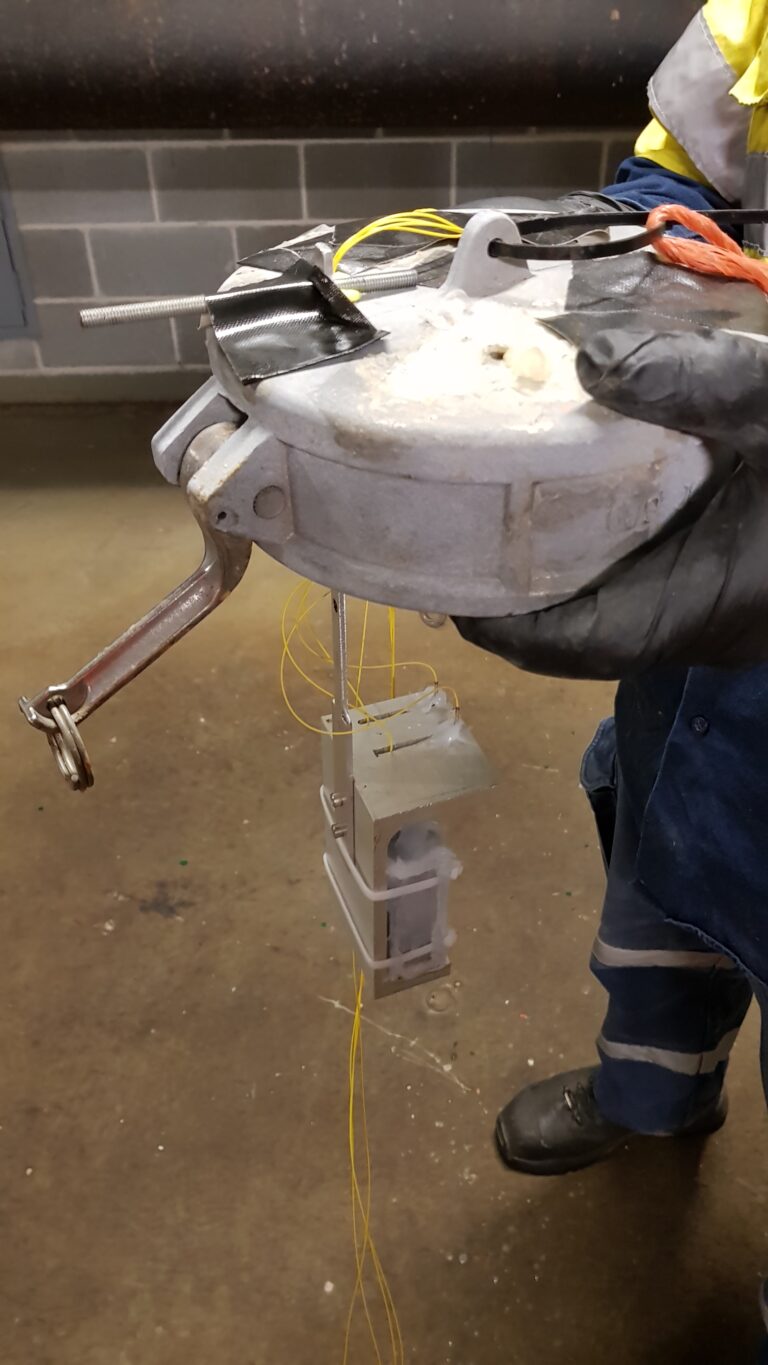
They developed a new photonic strain sensor that detects the physical onset of corrosion. This sensor was made of optical fibres and a smart coupon—a sacrificial concrete block that corrodes to measure acid corrosion rates.
Researchers developed this cost-effective sensor and its accessories so that it can be readily installed by trained technicians.
Researchers also conducted the first-ever field test in which corrosion rates were measured in a wastewater environment.
Photonic sensors offer a more cost-effective and longer lasting solution compared with equivalent electronic monitoring technologies.
They also provide accurate advanced data which can be used to better assess conditions of pipes for targeted repairs and maintenance and help predict future maintenance needs for more strategic asset management.
Photonic sensing will reduce the need for manual pipe inspections which protects worker health and safety.
Altogether, these benefits have the potential to reduce huge costs to asset owners and the public.
The photonic sensor system will be further developed in another SmartCrete CRC project: Digital Twin Model Based on Physico-Chemical and Biosensors to Estimate End-of-Service Life of Sewers.
This subsequent project will deploy the photonic sensors developed in this project at multiple Sydney Water sites to gather data to develop a predictive end-of-service life model.
The subsequent project will also develop advanced machine learning techniques to analyse both historical and current real-time data and turn it into a tool for asset owners to better manage their concrete infrastructure.